Welcome to your first day at an international company.
Your English is good. Your coworkers are diverse and they seem nice.
What could possibly go wrong?
Your goal: survive 6 workplace situations without accidentally starting office drama. If you can, congrats! you are a natural global employee.
So, wonder how you’d fit in at an international company?
If you answered mostly by clicking the third option, then congrats! You already seem comfortable approaching differences with curiosity and respect.
Keep in mind, being respectful does not mean agreeing with everyone, staying quiet, or being afraid of saying the wrong thing. It means knowing how to communicate when the person in front of you may see things differently.
What You Must Know
“Different Does Not Mean Wrong.”
When we encounter behavior or people that feel unfamiliar, our first instinct is to measure it using the parameters we already know. A coworker might avoid eye contact, disagree with a manager more directly than you would, or approach a problem in a completely different way. It is easy to immediately think, “That’s rude,” “That’s unprofessional,” or “That makes no sense.”
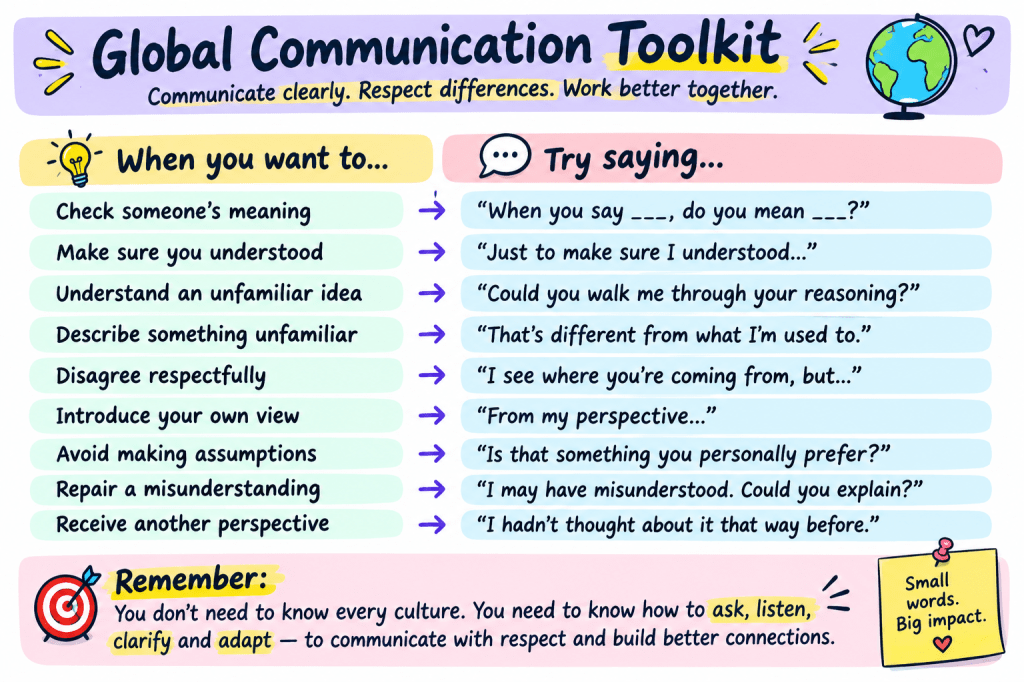
This does not mean you have to agree with everything another person does. It simply means giving yourself time to understand before making a judgement. Then, it is also important to keep communications respectful especially at work, Instead of saying, “That’s weird,” you could say, “That’s different from what I’m used to.” If you want to understand their thinking, you could try getting to know them and their cultural differences or you could follow it with, “Could you walk me through your reasoning?” if you find an unusual way of doing something when working together. That way, you are giving them a chance to explain themselves.
1. Clarify Instead of Guessing
Even when two people speak English fluently, the same sentence can be understood differently. For example, if someone said, “That’s interesting.” that does not always mean they find your idea interesting. If you are not completely sure what someone means, don’t hesitate to ask.
Try these:
- “Just to make sure I understood, you…?”
- “When you say ___, do you mean ___?”
- “Could you clarify what you mean by ___?”
- “So, if I understand correctly, you’re saying…?”
2. Disagree Without Closing the Conversation
Working with different people means you will disagree sometimes. You don’t need to hide your opinion, you just express it in a way that leaves room for discussion.
Instead of “You’re wrong” or “That won’t work,” try:
- “I see where you’re coming from, but…”
- “From my perspective…”
- “That’s interesting. In my experience…”
- “Could you explain why you see it that way?”
You can disagree and stay curious at the same time.
3. Be Curious Without Stereotyping
Knowing about cultural differences can be useful. The problem starts when “This can happen in this culture” becomes “Everyone from this culture must be like this.”
If someone’s behavior is unfamiliar or uncomfortable to you, ask about them, rather than making them represent their entire country or culture.
Try:
- “Is that something you personally prefer?”
- “Is that common in your experience?”
- “That’s different from what I’m used to. Could you tell me more about it?”
Culture can give you context. The person gives you the answer.
When a Misunderstanding Happens
You will misunderstand people sometimes, and they will misunderstand you too. What matters is knowing how to fix the conversation.
If you misunderstood them:
- “I may have misunderstood. Could you explain?”
- “Sorry, I interpreted that differently.”
If they misunderstood you:
- “Sorry, that’s not quite what I meant.”
- “Let me explain that another way.”
That is entirely better than being angry or panicking.
Or if something you said came across badly:
- “Sorry, that came across more strongly than I intended.”
- “I didn’t mean it that way.”
You don’t need perfect cross-cultural knowledge. You need enough English to ask, clarify, listen, and respond. People will know that you are a respectful individual who are just not unfamiliar with their culture.
Expressions of the day to remember!
 INCLUSIVE ENGLISH PROGRAM
Leave a comment